Thursday, March 28, 2024

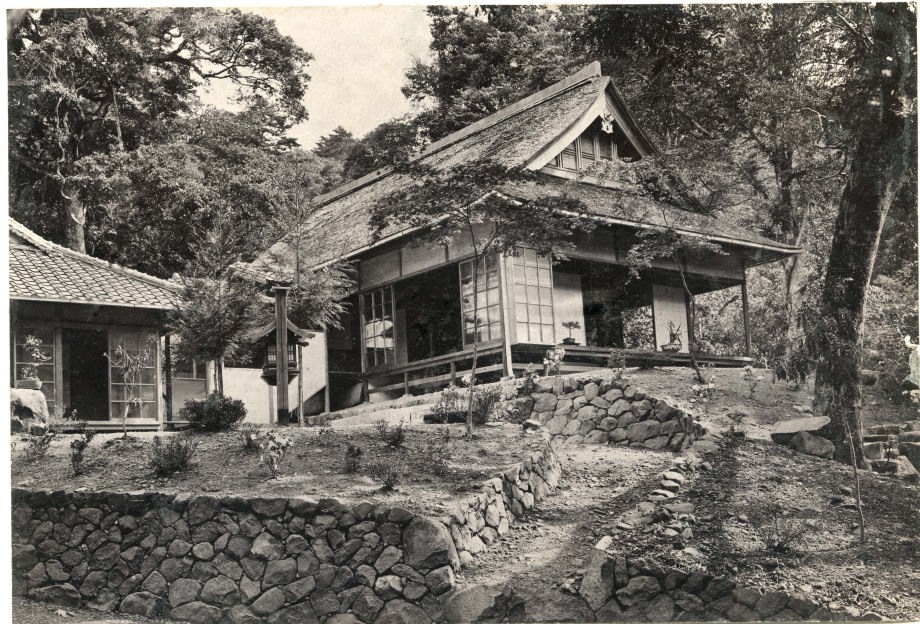
久保田写真館 高野山 to F. M. Trautz *

久保田写真館 高野山 to F. M. Trautz

久保田写真館 (Kubota Photo Studio) in Koyasan, Wakayama, was a renowned photography studio with a rich history. Founded by Norimatsu Kubota, the studio was known for its high-quality work and artistic approach to photography. It became a well-respected establishment, serving both locals and visitors to Koyasan.

The studio's legacy took a tragic turn when Norimatsu's son, Koichi Kubota (久保田耕治), was born in 1935. Little did Norimatsu know at the time that his son would later become a victim of a shocking crime. In 2006, at the age of 71, Koichi Kubota was tragically murdered at the studio by a high school student. This event deeply impacted the community and left a profound mark on the history of the Kubota family and their photography studio in Koyasan.


Monday, March 25, 2024

森馬壽商店 to エフ・エム・トラウツ *

森馬壽商店 to エフ・エム・トラウツ

This postcard, postmarked in Nara on January 1, 1933, was sent by Morimasu Shoten to F. M. Trautz. Morimasu Shoten was known for selling Nara-zuke.

Nara-zuke is a type of Japanese pickle that originated in the Nara region of Japan. It is typically made by pickling vegetables in a mixture of rice bran, salt, sugar, and sake lees (called "sake kasu"). The vegetables are usually left to ferment for a period of time, which gives them a unique flavor and texture.

Nara-zuke is known for its sweet and tangy taste, as well as its crunchy texture. It is often served as a side dish or snack and is popular in the Kansai region of Japan, particularly in Nara and Kyoto. Nara-zuke is also considered a traditional souvenir from Nara and is often sold in gift shops and markets in the area.

Friday, March 22, 2024

内藤虎次郎 Sinologist to トラウツ先生 **

内藤虎次郎 Sinologist  to トラウツ先生

This 1933 dated New Year's card from 内藤虎次郎 (Naitō Torajirō), also known as 内藤湖南 (Naitō Konan) is addressed to Dr. Trautz and his wife. 

内藤虎次郎 (Naitō Torajirō), also known as 内藤湖南 (Naitō Konan)

Naitō Kojirō (1866–1934) was a pioneering Japanese historian, philosopher, and scholar of Chinese and Japanese history. Born in Kazuno, Akita in 1866, he completed his education there before starting his career as a gradeschool teacher. Later, he moved to Tokyo, where he worked as a reporter for several newspapers. In 1901, he was invited to teach at Kyoto University, eventually becoming a professor.

In 1899, at the age of 33, Naitō embarked on a journey to China, driven by his deep interest in Chinese culture, language, and philosophy, as well as a desire to advance his scholarly pursuits. During his time in China, he immersed himself in the study of Chinese thought and culture, studying under prominent Chinese scholars, visiting historical sites, and engaging with the local community. This experience broadened his intellectual horizons and deepened his understanding of East Asian thought.

One of the highlights of Naitō's trip to China was his study of Confucianism and Taoism, two philosophical traditions that greatly influenced Chinese intellectual history. His interactions with Chinese scholars and firsthand experience of Chinese culture provided him with a deeper insight into these philosophies and their impact on Chinese society.

Naitō's scholarly focus was on the history of Japanese thought, particularly the study of ancient Japanese texts and the development of Japanese Buddhism. He also made significant contributions to the study of Chinese philosophy and its influence on Japanese intellectual history. His research underscored the importance of understanding Japan's intellectual heritage within the broader context of East Asian thought.

Naitō Kojirō's journey to China was a transformative experience that not only enriched his understanding of Chinese culture and philosophy but also influenced his perspective on the cultural and intellectual connections between China and Japan. His experiences in China played a pivotal role in shaping his scholarly pursuits and his contributions to Japanese studies.

Wednesday, March 20, 2024

月日亭 奈良 Tsukihitei Ryokan to F. M. Trautz *

月日亭 奈良 Tsukihitei Ryokan to F. M. Trautz

Postmarked in Nara on January 1, 1933, this New Year's card is from 大内セイ (Ōuchi Sei) of Tsukihitei Inn, which is still in operation today. We believe Ōuchi Sei is a woman's name and that she likely ran the inn as the 女将 (okami), the female manager or proprietress responsible for overseeing the day-to-day operations of the establishment. The role of the 女将 is highly respected in Japanese culture, as they are seen as the face of the inn or restaurant and are responsible for ensuring guests have a pleasant and comfortable stay.

I cannot say whether the reading of 月日亭 has changed over the years, but Trautz pronounced it as 'Getsu-Jitsu-Tei' in 1933, based on his handwritten notation on this postcard. 

Tsukihitei Ryokan ca.1905

Sunday, March 17, 2024

笹原喜作 of 敷香郡 樺太 to F. M. Trautz *

笹原喜作 of 敷香郡 樺太 to F. M. Trautz

This card was sent by Sasahara Kisaku (笹原喜作) of Kitonkan, Shikika-gun, Karafuto (気屯館 敷香郡 樺太). The postal marking, 樺太敷香 / 8. 1. 1, indicates it was sent from Shikika, Karafuto on January 1, 1933.

The character '館' (kan), as in 気屯館, means 'building.' In the context of a place name like 'Kitonkan' (気屯館), it likely refers to a hotel or an inn. Additionally, from the penciled notation written by Trautz himself that reads 'Hotel in Shikika,' there is no doubt that it was indeed a hotel. Furthermore, Trautz's contemporary written note clarifies the reading of 敷香 as 'Shikika,' which is particularly helpful today, as there have been questions regarding the correct reading of the word, which could also be pronounced as 'Shisuka' and 'Shikuka.'

Shikika circled in red

Sasahara makes an error in addressing one of the recipients. He writes "エフ・エム・トラウツ" and "エフ・エム・ヒルタ."  Sasahara referred to both Trautzs as エフ・エム. Sasahara's error in addressing the recipients could have been due to several reasons:

  • Misunderstanding or Misinterpretation: Sasahara may have misunderstood the proper way to address the recipients or misinterpreted their titles or names.
  • Confusion: Sasahara might have been confused about the correct titles or names of the recipients, leading to the error.
  • Assumption: Sasahara may have assumed that both recipients shared the same title or name format, leading to the incorrect addressing.
  • Lack of Information: It's possible that Sasahara did not have complete or accurate information about the recipients, which led to the error in addressing them.

Tuesday, March 12, 2024

From 永田信吉 (泊居郡 樺太) to F. M. Trautz **

From 永田信吉 (泊居郡 樺太) to F. M. Trautz 

This card bears the postmark of 泊居 (Tomarioru) dated January 2, 1933, and was sent from 永田信吉 (Nagata Nobukichi) to ドクトル エフ・エム・トラウツ様 (Doctor F. M. Trautz). 泊居郡 (Tomarioru District) 名寄村 (Nayori Village) was located on the island of Karafuto. Nagata was likely an educator.

Nagata wrote a note in Romaji: 'okuni e okaeri natta / yoni kikimashita node / goburai o itashimashita / okusamanimo yoroshiku' (お国へお帰りなったように聞きました ので ご無礼 をいたしました、 奥様にも よろしく).

As the context of this note is unknown, its translation is based on a presumed context, 'I heard that you have returned to your home country, so I apologize for not contacting you sooner. Please give my regards to your wife as well.'

Romaji, which refers to the Romanization of the Japanese language, has a history that dates back to the 16th century when Jesuit missionaries devised a system to transcribe Japanese words using the Latin alphabet. However, the widespread use of Romaji as a method for writing Japanese text, particularly for non-Japanese speakers, began to gain popularity in the late 19th and early 20th centuries as Japan opened up to the West. 

泊居 (Tomarioru) is framed in red above


Sunday, March 10, 2024

樺太真岡町から ヒルダ・トラウツ への年賀状 *

樺太真岡町から ヒルダ・トラウツ への年賀状

This is an interesting pair of New Year's cards from Miyamoto Komakichi of Sumirekan in Maoka-cho, Karafuto (宮本駒吉, 菫館 樺太真岡町). They were not only sent to F. M. Trautz but also to his wife, "ヒルタ-Hilta" (Hilda von Landwüst Trautz, 1887–1973). Based on my limited knowledge, correspondence addressed to Hilda is very uncommon.

Maoka-cho was a town that existed in Karafuto during Japanese occupation. Karafuto (樺太) was also known as Saharin (サハリン) in Japanese. It has a complex history, being inhabited by the Ainu people and later becoming a disputed territory between Japan and Russia. The southern part of the island was under Japanese control from 1905 to 1945, while the northern part remained Russian territory. After World War II, the entire island came under Soviet control.

Sumirekan would have been located where circled in red

Although these cards bear the same postmark dated January 1, 1933, with an acceptance mark of '真岡' (Maoka), they seem to have been processed an hour apart and by two different sorters, based on the different designs of the postmarks. Sumirekan seems to have been lost in history. It was likely a 旅館 (ryokan / small hotel / inn).

Wednesday, March 6, 2024

館太豊原 樺花屋旅 から エフ・エム・トラウツ *

Sent to F. M. Trautz from Hanaya Ryokan, Toyohara, Karafuto (January 1, 1933)

樺太豊原 花屋旅館 から エフ・エム・トラウツ

This hotel or inn appears to have been quite well-known, as I was able to find multiple postcards featuring its image. The two images on this postcard were obtained from the following sites:

https://rmda.kulib.kyoto-u.ac.jp/collection/asia-pc/sk

http://gazo.library.city.sapporo.jp/

Hanaya Inn Karafuto

Trautz's time in Japan must have been filled with remarkable journeys, evident from the wide-ranging correspondence he received from all corners of the country. From the bustling streets of Kyoto, where he resided, to the distant reaches of Hokkaido and Karafuto, the adventures of Trautz unfolded across Japan. The recently published Die Sammlung Trautz sheds light on their travels, revealing a rich tapestry of experiences. This new discovery adds a fascinating layer to our understanding of their journey, enriching the narrative of their time in Japan. Daniel Gerichhausen provides insights into the travels of the Trautzs in his work 'Hilda Trautz, Tagebuch Hokkaidō- und Karafuto-Reise' ('Diary Hokkaidō and Karafuto Trip' - ヒルダ・トラウツの '北海道・樺太旅行日記').

Die Sammlung Trautz

This postcard bears a postmark from Toyohara, the capital of Karafuto (now Yuzhno-Sakhalinsk), which was the Japanese name for the southern part of Sakhalin Island, now part of Russia. Karafuto was under Japanese control from 1905 to 1945, with Toyohara serving as its administrative center during that time. If you look closely, you'll notice a slight error in the address for Trautz. The name 'エフ・エム・トラウツ' was mistakenly written as 'エフ・イム・トラウツ,' with the イ crudely altered to エ, presumably to correct the mistake. 

Toyohara is colored in red on this map of Karafuto


Monday, March 4, 2024

小室昌信 から 都良宇津先生 (F. M. トラウツ) **

小室昌信 から 都良宇津先生 (F. M. トラウツ)

Komuro Masanobu sends New Year's greetings to F. M. Trautz and his wife. This Komuro was likely the father of 小室昌義 Komuro Masayoshi (see our post dated February 21, 2024), evident from their shared surname and address.

The card is addressed to 都良宇津先生 (Dr. Trautz - To-Ra-Wu-Tsu-Sen-Sei) and his wife. On the verso, similar text appears, but reading ドクトル都良宇津先生 / ドクトル・トラウツ先生夫人様, using both kanji and katakana for the name Trautz. In addition to their names, Komuro wishes them good health and luck in their research.

March 17, 1932 Nippon Shinbun (Sao Paulo, Brazil)

After a thorough internet search, only a single result was found regarding Komuro Masanobu of Kyoto. His name appeared in the March 17, 1932 issue of the Nippon Shinbun (Japan Newspaper Company, Brazil, São Paulo), where it was noted that his poem (tanka 短歌) was one of five selected from the general public by Emperor Hirohito for that year (see photo). These selected poems were featured in the New Year's Poetry Reading Ceremony, held on January 18, 1932, at the Imperial Palace. The theme for this year was "The Cock's Crow at Dawn" or "The Voice of the Dawn Rooster." 

Tanka by Komuro Masanobu 小室昌信の短歌  (昭和7年)

しらみゆく 夜船のまとに 聞ゆなり (Shirami yuku yofune no mato ni, kikoyu nari)

みなとの町の にわとりのこえ  (Minato no machi no niwatori no koe)

An article published in Time Magazine on February 1, 1932, sheds light on the annual tradition:

"The greatest New Year's honor that can befall a Japanese is to have his poem recited to His Imperial Majesty the Emperor Hirohito. Less than ten poems are recited. All must be on the same subject (chosen in advance by the Imperial Household Ministry). All must be in the requisite tanka form of 31 syllables in lines of five, seven, five, seven and seven syllables. Each year at least 30,000 Japanese poets strive for the honor. U. S. cable companies are grateful for the fact that Japanese living abroad usually wire their contributions. Those who do not win have another consolation: some may be invited to the Phoenix Hall of the Imperial Palace to hear the tankas composed by members of the Imperial family. This ceremony occurred last week. Subject of this year's composition was "The Cock's Crowing at Dawn..." 

Wednesday, February 28, 2024

大山公淳 から エフ・エム・トラウツ先生様 **

Ōyama Kōjun to Doctor F. M. Trautz

大山公淳 から エフ・エム・トラウツ先生様

Ōyama Kōjun (1895-1992) sent this New Year's card to Trautz from Wakayama Koyasan, Koyasan University Library on January 1, 1933. Ōyama was working there as a librarian and associate professor when he sent this note. Later in 1933, he became a full professor at Koyasan University. He authored many works on Buddhism throughout his life.

Ōyama's choice of addressing Trautz as トラウツ先生様 ("Trautz sensei sama") was clearly respectful, but overly so and unnecessary, as it is akin to saying "Mister Professor Trautz."

Sunday, February 25, 2024

関口林蔵 から 都良宇津 (トラウツ)への 年賀状 *

関口林蔵 から 都良宇津 (トラウツ)への 年賀状

This New Year's wish was sent to F. M. Trautz from Sekiguchi Rinzo at the Yamashima Police Station in Kyoto. Sekiguchi's use of the kanji 都良宇津 (To-Ra-Wu-Tsu) to address Trautz is highly unconventional; many would have used the katakana version トラウツ instead.

Regarding Sekiguchi, it appears that history has forgotten him, as there is no information available online or any references to him in written records.

Wednesday, February 21, 2024

小室昌義 Komuro Masayoshi to F. M. トラウツ **

小室昌義 Komuro Masayoshi to F. M. トラウツ 1933年

This 1933 postcard is addressed to Trautz and his wife and was sent by Doctor Komuro Masayoshi, author of インスリン注射後ノ初期血糖上昇ニ就テ (On the Initial Blood Sugar Elevation After Insulin Injection) published in 1929. It carries a quaint touch, as he also wrote the names of his wife, along with his son and daughter, in pencil: 禎子 (Yoshiko? Sadako?), 光子 (Mitsuko), and 和信 (Kazunobu). 

Sunday, February 18, 2024

溝渕進馬 to F. M. Trautz 1933年1月1日 *

溝渕進馬 Mizobuchi Shinma to F. M. Trautz

溝淵進馬 (1871-1935) was a Japanese educator. What makes this postcard interesting is Mizobuchi's signature in ink next to his Japanese name on the verso. For more comprehensive information on Mizobuchi, see below.

五高の歴史・落穂拾い

旧制第五高等学校の六十年にわたる想い出の歴史のエピソードを集めている 五高東光会の誕生

https://blog.goo.ne.jp/momotyann_1937/e/db8c7a9f57b6b53089dc1dcd7ab41bd7

Wednesday, February 14, 2024

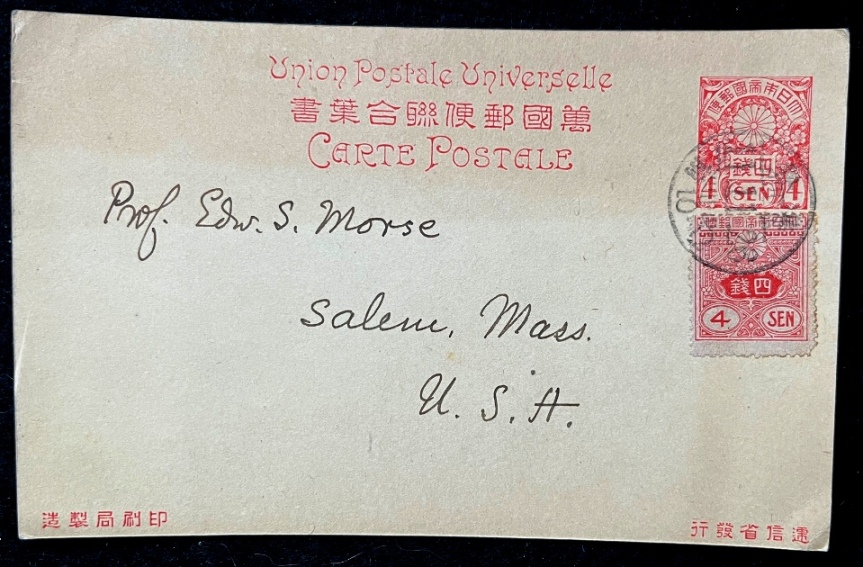
モリース・コスマン 1889 Maurice Cossmann to エドワード・S・モース

Maurice Cossmann (Alexandre Édouard Maurice Cossmann), French paleontologist and malacologist.

モリース・コスマン 1889 Postcard Maurice Cossmann エドワード・S・モース

Addressed to Professor E. S. Morse Esq. at the Peabody Academy of Science in Salem, Massachusetts, U.S.A., this letter bears the acceptance postmark, stamped twice, from LILLE (France), dated December 14, 1889. In addition to this, there are postmarks from London on December 14 and New York on December 24.

A peculiar circular stamp with the inscription "PAID / J / ALL" is also present. Despite not being a postal collector and, therefore, unable to definitively identify the purpose of this stamp, its size and upside-down stamping align with the New York postmark. This suggests that the stamp originates in New York.

The sender of this postcard, composed in French longhand and unfortunately beyond my ability to translate, is Maurice Cossmann, a distinguished French paleontologist and malacologist. The note seems to allude to a publication on brachiopods, but my understanding ends there. Intriguingly, he signs as "C. Maurice," an unconventional choice as Maurice is his first name followed by just the initial of his last name.

Alexandre Édouard Maurice Cossmann (1850–1924) was a distinguished French paleontologist and malacologist, whose significant contributions left a lasting impact on the fields of invertebrate paleontology and malacology. Born in Strasbourg, France, Cossmann dedicated his career to the study of fossilized shells, with a particular focus on brachiopods.

Cossmann's research encompassed a wide range of topics within invertebrate paleontology. He conducted extensive studies on the taxonomy, morphology, and classification of fossilized marine life. His work was characterized by meticulous attention to detail, and he played a crucial role in advancing our understanding of the evolutionary history of various marine organisms.

One of Cossmann's notable achievements was his comprehensive research on brachiopods, a group of marine invertebrates with hinged shells. His expertise in this area contributed significantly to the refinement of brachiopod taxonomy, and his publications provided valuable insights into their paleobiology and distribution.

Throughout his career, Cossmann authored numerous scientific papers and publications, contributing substantially to the academic literature. His work not only enriched the knowledge base in paleontology and malacology but also influenced subsequent generations of researchers in these fields.

Despite the challenges of his time, Cossmann's dedication to scientific inquiry and his rigorous approach to research established him as a prominent figure in the scientific community. His legacy endures through his scholarly contributions, which continue to be referenced and built upon by contemporary researchers in the study of Earth's ancient marine life.

Tuesday, February 13, 2024

佐々木忠次郎からエドワード・S・モースへ 1910年5月1日

佐々木忠次郎からエドワード・S・モースへ 1910年5月1日

Sasaki Chujiro's postcard to Edward S. Morse dated May, 1, 1910. He writes:

Tokyo 1. May 1910

Dear Professor, 

A few days ago I have received your kind letter as well as your interesting paper - An early stage of Acmaea.

In June, I will depart Japan in order to travel Europe, and probably in the following November or December, I will visit you at Salem.

Yours very fauthfully

Prof. Dr. C. Sasaki
Tokyo, Japan

An early stage of Acmaea was published in the Proceedings of the Boston Society of Natural History, 1910, Volume 34, Number 8, pp. 318-323. The following review appeared in Geological Magazine, Volume 2, Issue 1, January 1915, pp. 41.

Sunday, February 11, 2024

竹中成憲からエドワード・S・モースへ 1900年6月5日

竹中成憲からエドワード・S・モースへ

Seiken Takenaka writes to Edward Morse on June 5, 1900

Public Hospital, Aomori, Japan
June 5th, 1900
Regards to /  Mrs. Morse / & / Edith / Mrs.-- / I beg your pardon.

Dear Professor, 

Thanks for your kindness of sending me the Pamphlet on Bubble blower"--Very interesting. I send you a new Jap Med Journal, which contained my essay e.i. I cut it out. Still I send you the empty pamphlet, because at any rate you would not read the Japanese. Just a joke! To Dr. Bigelow tell the same thing if you please. 

How is your family? I want to have the picture of your loving son Mr. J. G. M. [ Potteries I do not forget yet -- a long time] You only, Takenaka

Seiken (Hachitaro) Takenaka (1862-1925) emerges as a prominent presence within Morse's book Japan Day by Day 1877, 1878-79, 1882-83. Serving as Morse's assistant and interpreter during his initial years in Japan, Takenaka's early affiliation with Morse is well-documented. He pursued a medical education at the University of Tokyo and later transitioned into the role of a military doctor. Notably, Takenaka established his own hospital on Sado Island around 1905.

This card is particularly intriguing, as it extends regards to various individuals: Mrs. Morse (Ellen Elizabeth Owen Morse, the wife), Edith (Edith Morse, the daughter), Mr. J.G.M. (John Gavit Morse, the son), and Dr. Bigelow (William Sturgis Bigelow, longtime friend). Takenaka humorously includes a remark addressing Edith as "Mrs.," likely aware of her recent marriage in March 1898. However, it seems he was unaware that John Gavit Morse had also married in early 1899. Unlike the instantaneous news updates we are accustomed to today, in the past, it took considerable time for news to circulate, especially when letters sent overseas were infrequent.

It seems like Takenaka is expressing gratitude for receiving a pamphlet on bubble blowers. He acknowledges the kindness of the gesture and finds the pamphlet interesting. He then mentions sending Morse a new Japanese medical journal, along with his essay that he had cut out. He humorously adds that he is sending the empty pamphlet as well, jokingly implying that Morse wouldn't be able to read the Japanese content anyway. Takenaka concludes by asking Morse to relay the same message to Dr. Bigelow. This postcard appears to be a light-hearted and appreciative exchange.

The article appeared in Popular Science Monthly, May 1900, pp. 23-29. Below is the first paragraph of that monograph.

A BUBBLE-BLOWING INSECT
By Prof. E. S. MORSE

MANY years ago, while preparing an elementary book on zoölogy, I had occasion to make a drawing of the little insect which is found on grass and other plants immersed in flecks of froth. This substance is commonly known as frog spittle or cuckoo spit, and, being found in the spring, is known in France as "spring froth."

Friday, February 9, 2024

佐々木忠次郎からエドワード・S・モースへ 1922年11月26日

佐々木忠次郎からエドワード・S・モース

For whatever the reason, Chujiro Sasaki uses Roman numeral to denote month of the year. In this instance, he uses "XI" for November: 'Tokyo 26. XI. 1922' for this postcard sent to Edward Sylvester Morse. It appears Morse had sent him an article on soft-shell clams and a work relating to archery, a sequel to his 1885 "Ancient and Modern Methods of Arrow Release." 

Tokyo 26. XI. 1922

Dear Prof.

Today I have reveived your two papers - 

1. An abnormal shell of Mya arenaria 

2. Additional notes on arrow release - and read them with great interests. I should say much thanks to your kindness and am glad to hear your everlasting scientific works.

Yours very faithfully

Hon. Prof. C. Sasaki
Agric Coll. Tokyo
Imp. Univ.
Tokyo, Japan

Ancient and Modern Methods of Arrow Release

Additional notes on arrow release (1922), Salem, Mass., Peabody museum.

Below is an extract from that work: 

"In 1885 I published, in the Proceedings of the Essex Institute, a paper entitled "Ancient and Modern Methods of Arrow Release." From the difficulty I found in ascertaining the various attitudes of the hand in drawing the bow I began to realize that no one had made a study of the subject and that I had made a discovery."

An Abnormal Shell of Mya Arenaria, 1922, Nautilus, volume 36, pp. 28-30.

Below is an extract from that work:

"The many deformations in the shells of Mollusca have often been described and figured and their causes easily explained. Some of these deformations have been due to injuries to the shell in its early stages, others are due to an arrest of development — atrophy, or an access of growth — hypertrophy, as are the usual causes of malformations among the higher animals and man. In shells these malformations generally consist in the case of gasteropods of the whorls being separated, elongation of the spire, extra knobs, spines, ribs or keels or simple monstrosities; reversed twirls of the spire in dextral shells, supernumerary teeth in the aperture. These and other modifications of the shell are readily understood. I now present an example of an abnormal growth which has so far been inexplicable to me, and it is hoped that some reader of the Nautilus will solve the problem. Recently I received the right valve of the common clam, Mya arenaria, from my friend Major John M. Gould, who received it from Levi C. Carter of Loudville, Maine, who got it at Marsh Island, midway between the Kennebec and Penobscot Rivers."

From these writings, it becomes evident that Morse continued his lifelong research on various subjects until his death in 1925.

Tuesday, February 6, 2024

石川千代松からエドワード・S・モースへ 1900年12月28日


石川千代松からエドワード・S・モースへ

New Year's well wishes from Chiyomatsu Ishikawa to Edward Sylvester Morse

Bearing the postmark of December 28, 1900, from Tokyo, the note is dated January 1, 1901, in adherence to the customary practice of New Year's greeting cards. Chiyomatsu Ishikawa, once a student of Edward Morse during Morse's tenure at Tokyo University, sent this heartfelt greeting in German. Notably, it reached Morse on January 21, 1900, as indicated by the Massachusetts postmark

Ishikawa Chiyomatsu (石川千代松, January 30, 1861 – January 17, 1935) was a Japanese biologist, zoologist, evolutionary theorist, and ichthyologist who left an indelible mark on the scientific landscape of Japan. His significant contributions extended beyond his homeland, particularly in the realms of evolutionary biology and ichthyology. Notably, Chiyomatsu played a pivotal role in the early dissemination of Charles Darwin's groundbreaking evolutionary ideas within Japan, contributing to the broader acceptance and understanding of evolutionary theory in the country.

In 1878, Chiyomatsu embarked on his academic journey at Tokyo Imperial University, where he studied under the guidance of Edward S. Morse. His intellectual foundation expanded further as Morse's departure from Japan led him to influential mentors such as Charles Otis Whitman and Kakichi Mitsukuri.

After completing his studies at Tokyo Imperial University, Chiyomatsu pursued advanced research in Germany under the tutelage of the distinguished evolutionary theorist August Weismann. The experience abroad not only enriched his scientific knowledge but also fostered a global perspective on evolutionary studies.

Upon his return to Japan, Chiyomatsu assumed the role of an assistant professor at the University of Tokyo. Subsequently, he became a professor at the University of Agriculture (農科大学, Nōka Daigaku) from 1890 to 1924, where he continued to inspire and shape the minds of future scientists. His tenure at these esteemed institutions marked a period of significant academic influence, where Chiyomatsu continued his research, contributing to the advancement of zoology and evolutionary thought in Japan.